


Thank you for being here. You are receiving this email because you subscribed to Idée Fixe, the newsletter for curious minds. I’m Toni Cowan-Brown, a tech and F1 commentator. I’m a former tech executive who has spent the past five years on the floor of way too many F1, FE, and WEC team garages, learning about the business, politics, and technology of motorsports.

⏳ Reading time: 8 minutes
Shift Happens, weekly pivots where motorsport collides with tech and culture. A quick roundup of the headlines in and around motorsport you should be aware of. The great thing about the internet is that we have access to almost everything. But that’s also the issue. I hope you enjoy this new curated format.
The lead lap
First, I love that Snapchat is expanding its presence in sports and collaborating with more athletes - congrats to Alba on this partnership. Now for this week’s lead lap - Formula 1 has entered its most radical new era in over a decade, with sweeping changes to the power unit, aerodynamics, and car dimensions all arriving at the same time. The F1 teams are still out in Bahrain for another week of pre-season testing, and here’s what we know so far - the good, the bad and the truth.
The good
Let’s start with the fact that the ICE side of the power unit can run on 100% sustainable fuels, as F1 tries to meet its self-set goal of carbon neutrality by 2030. These advanced sustainable fuels were already trialled in F2 and F3 in 2025, and are made from sources such as carbon capture, municipal waste, and non-food biomass. I’ll also say that there seems to be a consensus that cars being shorter, narrower, lighter, and nimbler, with a shortened wheelbase, making them more responsive through corners, is a good thing.
The Red Bull Ford power unit was the story of the week. You’d struggle to find someone in the paddock who was not impressed - after running reliably throughout, it displayed impressive energy deployment on the straights to give Red Bull a significant advantage there. It ran for 670 laps across the Red Bull and Racing Bulls cars, turning a lot of heads. That said, World Champion, Max Verstappen, had some strong words about the new cars. He called them “Formula E on steroids”, “anti-racing”, “not fun”, and “not like F1” - with the Red Bull livery and the cars’ proportions the only redeeming features in his view. Strong words heading into the final test, but fear not, Formula E was there to turn these comments into marketing dust.
Ferrari quietly impressed. Lewis Hamilton completed a long run on the final day that was quicker than Oscar Piastri’s McLaren while they were both on track, and Charles Leclerc had compared favourably to Lando Norris on the second day. Ferrari also appeared to be on top of the chaotic 2026 start procedures, with its engine seeming able to minimise turbo lag better than rivals.
And then there’s the feel-good story of Cadillac. The American squad ran reliably and consistently throughout, completing more than 1,700km - around five race distances - as they focused on refining balance, set-up, and energy management.

The bad
Mercedes arrived in Bahrain following a very smooth run in Barcelona, but suffered a series of problems - first with the suspension, then with their power unit - which hampered their mileage. Kimi Antonelli managed just 33 laps across two days, compared to 110 for team-mate George Russell. They remain a strong overall package, but it was a frustrating week for a team many had pegged as favourites. To make things a little worse for Mercedes, the five engine manufacturers will vote next week on a potential mid-season rule change addressing the compression ratio row centred on Mercedes.
Aston Martin. Early indications suggest the AMR26 is too slow and very difficult to drive. And it’s worth repeating - it’s far too early to make any real assessments. The team’s development fell around four months behind schedule while they waited for Adrian Newey to finish his gardening leave, and new engine partner Honda appears significantly behind the curve on power unit development.
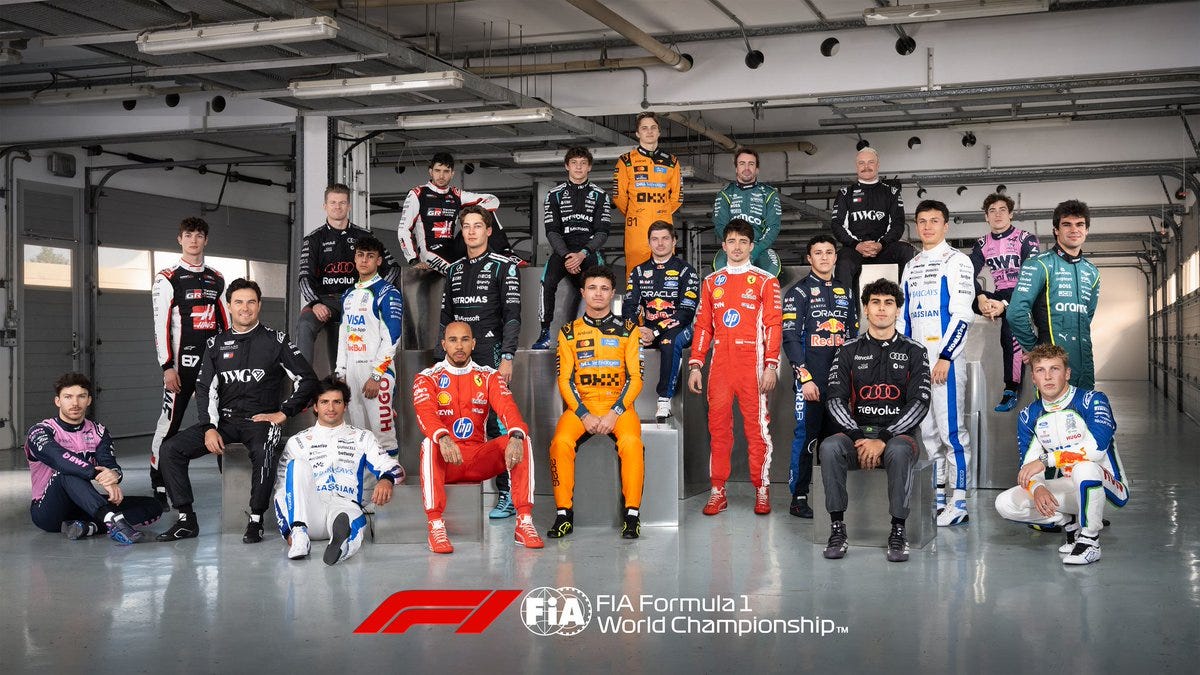
I’m also going to put this year’s driver picture in the bad section because this is simply not it and it’s been getting some heat on social media too, and rightly so.
The truth
The second and final test runs from February 18–20, also in Bahrain, before the season opens in Australia on March 8.
On February 18th, there was a Formula 1 Commission meeting and here’s what we know so far: As per the FIA’s press release, there will be “further evaluation and technical checks on energy management matters”, and these will obviously be carried out this week during the second week of testing. There will be no immediate major regulatory changes, “given that initial evidence and feedback remain immature and that premature change carries the risk of increased instability ahead of the first race.” A new race start procedure is currently being evaluated as we speak - specifically, the light sequence.
And in case you missed it, Apple TV now has an F1 section (clearly the F1TV migration is in full swing) and there is lots of content from pre-season testing now available to the American audience.
The number of the week
$1,000/seat was the starting price for the main All-Star Game in Los Angeles this past Sunday. The NBA All-Star weekend was this past weekend and a lot of people had a lot to say about it - mostly that the games looked very empty, attendance seemed low, and that may have something to do with the fact that the ticket prices were incredibly high. Now, I know very little about basketball, but I do know that if the demand isn’t there, the ticket prices shouldn’t be that high because it ends up being a loose/loose situation.
As The Athletic put it, the all-star weekend was simply not an in-person event for the fans - not anymore anyway, and empty stadiums like this is what happens when events become too corporate. And then there is the room that is made to accommodate the made, and this quote stood out:
Arenas give up seats to accommodate more media. Those “cheap seats,” where you might find the most raucous fans, are occupied by people working. That’s a good trade-off for the NBA, because the more voices amplifying the league, the better.
But the media doesn’t cheer — well, the media is not supposed to cheer.
And speaking of the NBA, just weeks after his legal battles with NASCAR, Michael Jordan’s team just won the Daytona 500 in one of the most insane finishes I’ve ever seen, and as Thandie put it, what a win in the midst of Black History Month.
Three stories that need to be on your radar
The second FE Evo session happened in Jeddah this past weekend, and I’m at a loss for words if I’m being completely honest. I was looking forward to doing a write-up on teh event and seeing how it compared to last year’s session, but I’ve decided against it. Leading up to the first Evo session last year in Miami, I was full of excitement and optimism. However, similarly to last year, it seems that the highlight of the weekend (or rather the piece of content being pushed far and wide on social channels) is a crash from one of the content creators who, after half a day in a simulator, took to the track. And the whispers from the FE Paddock are very much that this event should probably not happen again, and on this, I agree. That is, not until a proper training and safety programme is put into place. And I’ll leave it at that.
The World Endurance Championship is losing two significant names from its Hypercar ranks, with Alpine confirming just last week that it will exit the series at the end of 2026, following Porsche’s departure that was announced late last year. Together, they represent the third and arguably most consequential wave of manufacturer withdrawals since the Hypercar era began in 2021. Alpine joined the Hypercar class in its inaugural year and has competed in every season bar 2023, but with minimal success. The root cause of the exit is financial and strategic rather than purely sporting. Parent company Renault has been cutting down many of its motorsport projects across the board: in Formula 1, Alpine closed its power unit project to become a Mercedes customer team, while Dacia also ruled out a return to Dakar despite winning the most recent edition. The decision to focus exclusively on F1 rather than run a two-pronged motorsport programme reflects a leaner, more survival-oriented mindset from a brand that has been navigating a difficult period commercially and in terms of leadership. Porsche’s exit carries even more historical weight. The German marque has 19 outright Le Mans victories - more than any other manufacturer - making it the most storied name in endurance racing history. Porsche’s departure, like Alpine’s, stems from the same broader forces reshaping the automotive industry: rising costs, a difficult EV transition, and parent group Volkswagen navigating significant financial turbulence. The underlying theme with both exits is that running a top-level Hypercar programme is enormously expensive, and the return on investment - in terms of both sporting results and brand exposure - has proven harder to justify than anticipated. The silver lining is that the WEC’s top class remains well-stocked: Aston Martin entered in 2025, Genesis joins this season, and both McLaren and Ford have announced they will arrive in 2027.
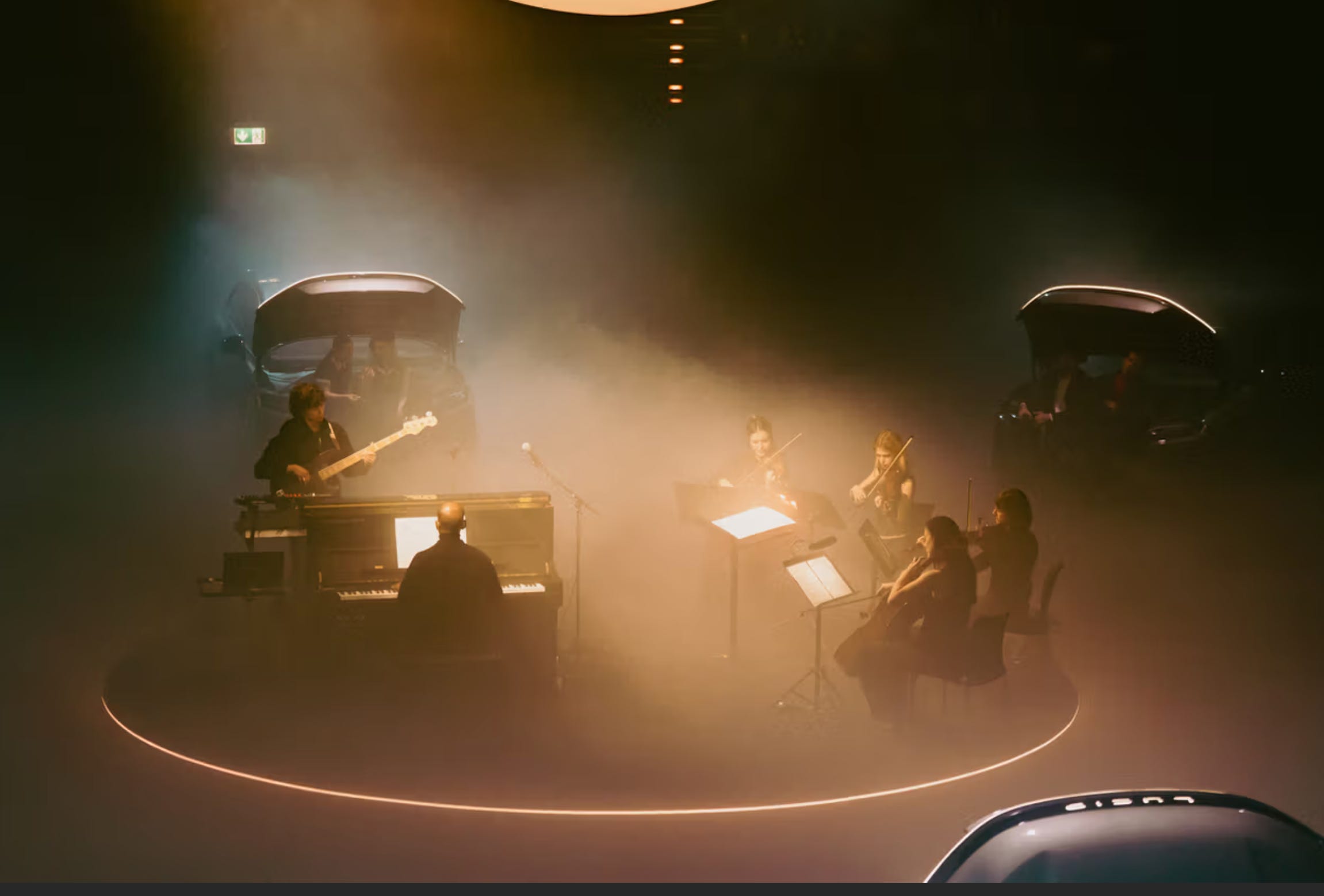
When car events look nothing like our parents’ car events. Hypebeast did a great write-up on last week’s event - Lucid showed up in style at Berlin’s International Film Festival. The event was described as “a cinematic multisensory event stepping into the world of its new all-electric Gravity SUV.”
One video worth your time
One thing we knew was coming and we could count on was that the 2026 engines would sound different, and potentially a little louder (to the delight of many F1 fans). Simply put, the removal of the MGU-H means the turbo no longer has to drive an electric motor, which reduces backpressure on the exhaust.
According to Mercedes engine boss Hywel Thomas, "the backpressure is reduced because the turbo doesn't have to drive the electric motor. This results in a slightly louder sound.” So no, the 2026 power units are not going to sound like the old V8/V10 era - there should only be a slight ‘improvement’. On top of that, the combustion engine will be burning less fuel, meaning it will be working less hard, which actually reduces noise in some respects.
But because the MGU-H is gone, teams can't recover enough energy from braking alone. So the engine now switches to full-throttle mode even while braking and cornering to generate extra electricity for the battery. This means we will hear high-rev engine noise in slow-speed sections, which is an unfamiliar sound compared to previous cars. So in short: the cars sound a bit more aggressive due to less exhaust backpressure, but the bigger story is the character of the sound changing - high revs in corners, a "different soundscape" - rather than a return to the roaring V10 days.
One [event] that caught my eye
Just your weekly reminder that we cannot separate sports from politics, the two are very much tied at the hip - whether you like it or not. This incredible video from Caolan is a great recap of how and why big sporting events have been used for political means. This is a topic I’ve spoken about in some detail previously, and will continue to do so.
