


Thank you for being here. You are receiving this email because you subscribed to Idée Fixe, the newsletter for curious minds. I’m Toni Cowan-Brown, a tech and F1 commentator. I’m a former tech executive who has spent the past five years on the floor of way too many F1, FE, and WEC team garages, learning about the business, politics, and technology of motorsports.
⏳ Reading time: 8minutes
Normally, these deep-dive stories go out on Thursdays. So first, thank you for bearing with me. I really wanted this week’s topic to cover Cadillac’s presence at the Super Bowl, as well as the other ways F1 teams and their sponsors had a presence there. The Athletic wrote a great piece that answers the question - why did Cadillac pick a Super Bowl ad and a Times Square reveal for their livery launch? - and it’s also well worth reading.
When Cassidy Towriss, Chief Brand Advisor for the Cadillac F1 Team, posed the question “what’s the most American thing we can do?” The answer that followed was: a Super Bowl commercial watched by 127 million people, combined with a Times Square spectacle that brings Formula 1 directly to the masses. And that’s exactly what we got this weekend. This Sunday, F1 witnessed something it’s never seen before - a team announcing itself not in a factory hangar or at an invite-only media event, but during the most-watched television broadcast in America. It’s audacious, expensive, unexpected, and that’s exactly the point.
Note: the Cadillac F1 Team asked me to attend the launch in Times Square, but with the Super Bowl on my doorstep, I decided to follow along from the comfort of my home. I am, however, working with the team on my takeaway of the launch, which will be live soon on Instagram.
The countdown & the reveal
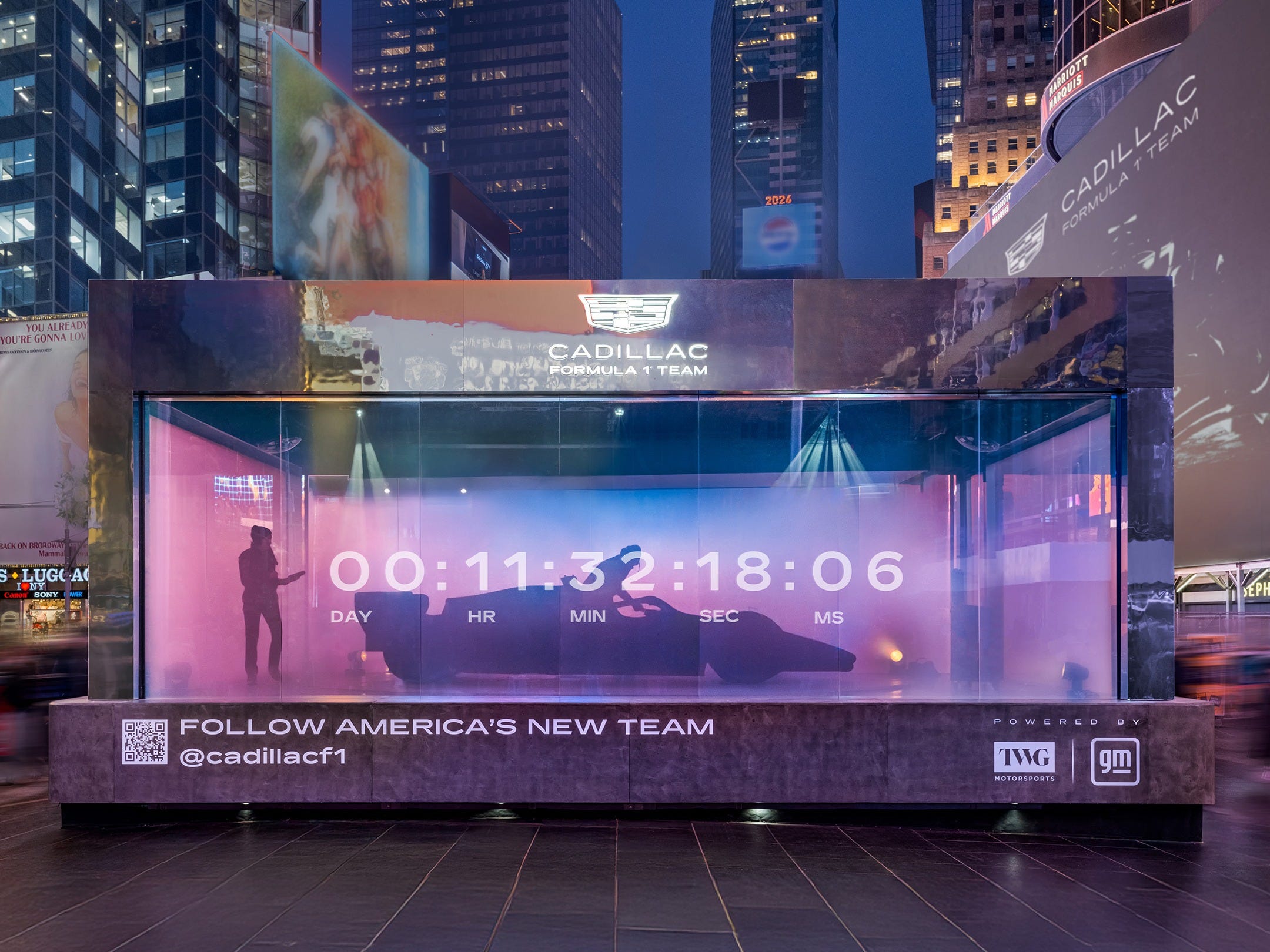
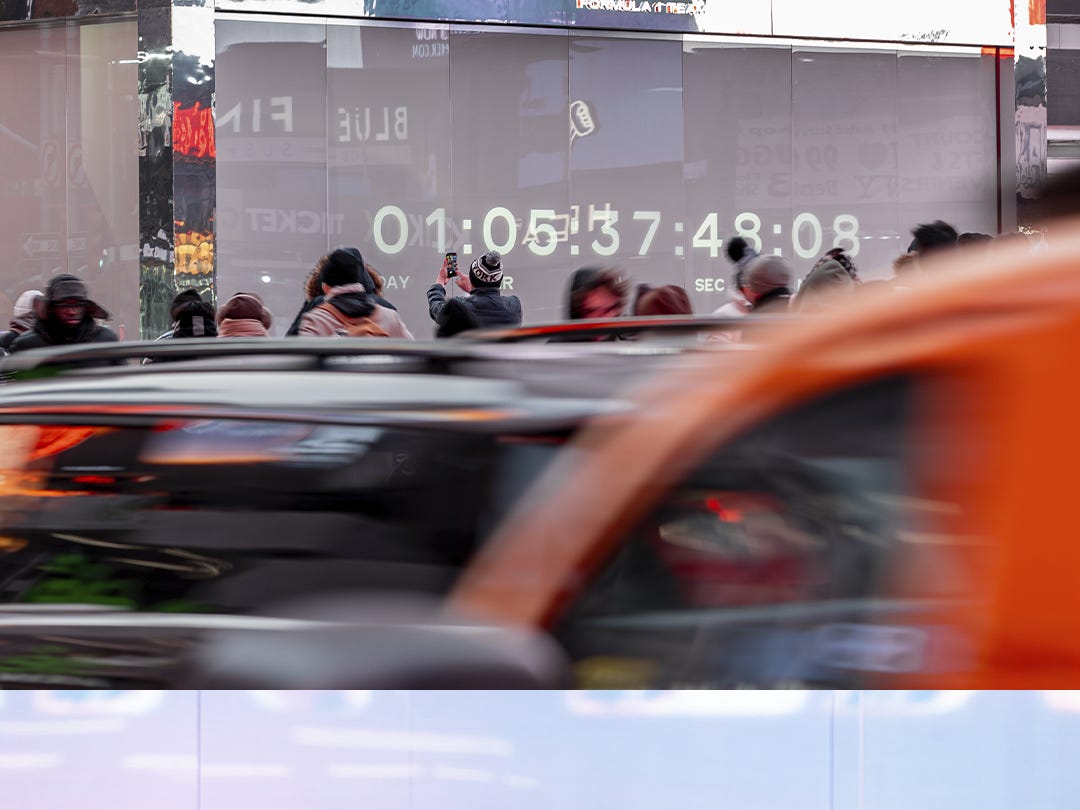
Since Friday, a giant frosted glass box appeared in Times Square, and it’s impossible to ignore. Inside sits a replica of Cadillac’s 2026 F1 car, obscured behind frosted panels, with a countdown ticking toward Super Bowl Sunday. This Cadillac Countdown Box represents a philosophical shift in how F1 teams introduce themselves. Livery reveals traditionally happen behind closed doors - exclusive media affairs, hospitality suites, YouTube streams for the converted. Cadillac brought F1 to the people instead.
“A Super Bowl spot is a one-way conversation,” Chief Marketing Officer Ahmed Iqbal explained. “You get seconds on a screen, then it’s gone.” Times Square gives the reveal physical permanence and creates genuine intrigue - the glass will become transparent in sync with the commercial, allowing anyone to see the livery in person. On February 9th, the car will remain on display for public viewing. No credentials or special access required. In an era when democracy is being tested, this feels, in some way, very democratic.
And this certainly is one way to bring Formula 1 to the average American - and the many tourists - and create intrigue and interest to a potentially curious fan. It’s also worth pointing out that they are not the only team present in Times Square, the Aston Martin F1 Team has also taken over Times Square with a massive ad, featuring none other than the face of design legend Adrian Newey and driver lineup - Lance Stroll and Fernando Alonso.
The ‘all-American’ ad
Now, for the Super Bowl commercial, with a potential 130 million viewers, it certainly was the answer to “what’s the most American thing we can do?” - a question Cassidy Towriss, Chief Brand Advisor for the Cadillac F1 Team, had put on the proverbial table.
For some context, especially for my fellow Europeans, Super Bowl commercials cost approximately $8 - $10 million for 30 seconds - that does not include production, celebrity fees, or pre-game marketing. For perspective, Apple’s legendary “1984” Macintosh ad cost the equivalent of $2.7 million today. Amazon’s 2022 Alexa spot reportedly cost $26 million for two minutes.
But Cadillac isn’t selling a product available tomorrow. They’re selling a dream that won’t manifest until March 2026. As Madeline Coleman wrote in The Athletic, they must convey “the racing, the underdog story, its determination, to create this big, unifying moment” in 30 seconds. The ad played at around 6:40 pm PT in the fourth quarter of the game, to the sound of President John F. Kennedy’s famous 1962 speech about going to the moon. A statement about being bold, daring, and starting from scratch. A statement about racing against European giants who’ve perfected their craft for decades. A statement about being unapologetically American.
The ad, directed by Sam Pilling with a score by Oscar nominee Max Richter, prominently featured Apple TV+, F1’s exclusive U.S. broadcaster - a clever cross-promotion that gives both brands a stake in each other’s success. The gamble: convince America that Formula 1 matters, and that they should care when an American works team takes the grid for the first time in decades.
The story begins here | The legacy
To understand Cadillac’s approach and why the above ad makes so much sense, you need to understand how improbable their presence on the grid actually is. In January 2023, Michael Andretti announced his intention to bring an American team to F1, backed by GM and Cadillac. The FIA approved it. Liberty Media rejected it, stating the Andretti name wouldn’t “provide value to the championship.”
What followed was Shakespearean. Mario Andretti lobbied Congress. The DOJ opened an antitrust investigation. At a 2024 Miami party, Liberty CEO Greg Maffei allegedly told Mario: “I will do everything in my power to see that Michael never enters Formula 1.”
In October 2024, Michael stepped back. Dan Towriss took control. The Andretti name vanished from materials. GM committed to building its own power unit by decade’s end, investing $140-150 million in a new engine facility. The team paid a $450 million expansion fee - more than double the original demand.
November 2024: provisional approval. March 2025: official confirmation. The investigation dissolved. Michael Andretti, at St. Petersburg, said he’s “very happy” now. Mario, 86 and on Cadillac’s board, was poetic: “My first love was Formula 1 and now - some 70 years later - the F1 paddock is still my happy place.”
The story Cadillac tells isn’t about an ad or installation. It’s about an American manufacturer that refused to take no for an answer, that endured a lot to get here, that paid every toll until the door opened. And now that it’s been opened, you can best bet they will do everything they can to stay and build a legacy worth talking about. It’s the underdog narrative that American sports culture was built on.
Now they’re announcing themselves to 130+ million people who might not know what DRS is, but understand what it means when someone fights for their seat at the table.
So much more than a football match | The fashion
There is another, just as strategic but maybe less obvious, aspect worth talking about and that’s the fashion aspect of it all. Thom Browne skipped New York Fashion Week entirely to show his Fall/Winter 2026 collection at the GQ Bowl in San Francisco during Super Bowl weekend. Not a capsule collection - his entire main line, presented at the Legion of Honor Museum on February 6. I also noticed that the Audi Revolut F1 Team was out in force, too, in San Francisco with a show car, which I absolutely loved.
GQ selected Browne for his football connection - he’s served as artist-in-residence for Notre Dame. But the real reason is simpler: “Every Sunday, you see NFL players wearing Thom Browne,” said Will Welch, GQ’s outgoing editor-in-chief. He’s also dressed the likes of Daniel Ricciardo, Morgan Riddle, Serena Williams... and rightly named the ‘king of sports-fashion crossover’. NFL Commissioner Roger Goodell told The Business of Fashion, the league is “putting increasing focus on the intersection between sports and fashion, because we think our fans care deeply about it, our players care deeply about it.”
The numbers validate this shift. In 2023, Instagram reported that posts featuring NBA and WNBA player tunnel looks had 25% higher engagement than regular sports content. A Shopify report found 40% of users under 30 purchased items they’d first seen on athletes, and fashion houses responded en masse. The convergence, some have argued, may have reached saturation.
Which brings us back to Cadillac. Their Tommy Hilfiger partnership for team fanwear isn’t just merch - it’s part of this cultural moment where sports entities are aiming to claim fashion legitimacy. The reality is that even though the collection is a lot more thoughtful than most team kits (and I believe we have Cassidy Townriss to thank in large part for this), it’s still very much merchandse, not a fashion collection. That being said, I’m excited to see what else we can expect from a team that is willing to disrupt the status quo.
Creating a new blueprint
From the start, Cadillac ignored the script. They hired veterans Sergio Pérez and Valtteri Bottas instead of chasing the romantic notion of an American driver. They partnered with Tommy Hilfiger for fanwear. They built facilities in Indiana, Michigan, and North Carolina - not just the UK motorsport valley - making this genuinely transatlantic.
They revealed their livery in a Super Bowl ad, rather than at the factory or a fancy exclusive event. They’re putting their car in Times Square instead of hosting a press conference. They’re treating F1 not as a gentleman’s club requiring polite entry requests, but as a global sport that happens to have an American team now.
Ahmed Iqbal said it plainly: F1 launches aren’t accessible. “They live in environments that require context to enter: press rooms, private invitations, and million-dollar sponsorship deals.” It acknowledges a truth: F1 has tried to crack America for decades with limited success. Drive to Survive changed that. The Brad Pitt movie helped. But to truly cement F1 in American culture, you can’t just host races in Miami, Austin and Vegas. You have to go to living rooms during the Super Bowl, to Times Square, to Instagram feeds.
Cadillac isn’t asking for permission anymore. They paid $450 million. They satisfied every requirement. Now they’re introducing themselves the only way that makes sense for America’s team in a European sport: loudly, proudly, during the most American cultural moment of the year. Whether the car is fast remains to be seen - and that’s the case for all eleven teams on the grid. Whether this works - whether Super Bowl viewers become F1 fans, whether Cadillac becomes synonymous with American motorsport - that’s a question for the 24 races that follow.
But for one night in February, Formula 1 didn’t just happen somewhere else. It was in the middle of the Super Bowl, in the heart of Times Square, on America’s doorstep - unapologetically American and impossible to ignore. And that might be the most revolutionary thing Cadillac brings to Formula 1.