


Thank you for being here. You are receiving this email because you subscribed to Idée Fixe, the newsletter for curious minds. I’m Toni Cowan-Brown, a tech and F1 commentator. I’m a former tech executive who has spent the past five years on the floor of way too many F1, FE, and WEC team garages, learning about the business, politics, and technology of motorsports.

⏳ Reading time: 5 minutes
Shift Happens, weekly pivots where motorsport collides with tech and culture. A quick roundup of the headlines in and around motorsport you should be aware of. I hope you enjoy this new curated format.
The lead lap
We always knew the 2026 F1 season was going to be messy, complicated, interesting and a rollercoaster ride. And I would say that things are just kicking off, and right now, ahead of the pre-season testing in Bahrain, all teams seem to be focused on one engine in particular, so let’s talk about it.
Formula 1’s 2026 regulations lowered the maximum engine compression ratio from 18:1 to 16:1 - a change meant to ease development and align with sustainable fuels. But Mercedes (and to a lesser extent Red Bull, and we’ll come back to that) have found an ingenious workaround: the rules measure compression ratios “at ambient temperature” when engines are cold and stationary. By using materials with specific thermal expansion properties, their components expand at operating temperature, effectively pushing compression ratios back toward 18:1 during actual racing while still passing the static 16:1 checks. Clever, really, and a very literal translation of the FIA rules.
The potential advantage is significant - reports suggest 10-13 horsepower, worth two to three tenths per lap. As a reminder, Mercedes is also supplying McLaren, Williams, and Alpine, so eight cars total could benefit from this ‘loophole’. Ferrari, Honda, and Audi have jointly complained to the FIA, arguing this violates the spirit of the regulations. Mercedes argues they’ve followed the letter of the law, and technically, they’re right.
Red Bull’s position in this controversy is particularly interesting. The knowledge likely reached Red Bull Powertrains through former Mercedes personnel - hardly surprising given Red Bull’s recruitment from Mercedes High Performance Powertrains for their in-house engine project. But here’s the twist: paddock rumors suggest Red Bull attempted to replicate Mercedes’ approach but couldn’t match the gains. This matters because forcing a regulatory change requires a supermajority -four of the five engine manufacturers plus the FIA and Formula One Management. Audi, Ferrari, and Honda needed Red Bull onboard, and now they have them. Red Bull’s flip could be the deciding vote that outlaws Mercedes’ clever engineering. if, and big if, it comes to this.
The FIA is caught between precedent and intent. Changing rules mid-stream because rivals missed the same loophole could set the wrong standard, in my opinion, as we want teams to constantly push the boundaries of the sport and regulations. Yet the governing body clearly intended to reduce compression ratios across the board.
FIA director Nikolas Tombazis wants a resolution before the Australian Grand Prix, with multiple manufacturer meetings underway. The goal: keep this out of the courtroom and find a solution before the season starts - though any meaningful technical response from competitors wouldn’t be feasible until 2027 at the earliest - making any changes to a power unit is no small feat.
The number of the week
135 million. That’s potentially how many people tuned in on NBC to watch the 2026 Apple Music Super Bowl halftime show with Bad Bunny. This would make it the most-watched halftime show. This is according to a report by CBS News, although they did not say how they arrived at this estimate.
Three stories that need to be on your radar
The Cadillac F1 Team launch happened, and they did something no team has ever done before. Cadillac isn’t asking for permission anymore. They paid $450 million. They satisfied every requirement. Now they’re introducing themselves the only way that makes sense for America’s team in a European sport: loudly, proudly, during the most American cultural moment of the year. Cadillac’s launch involved a reveal in Times Square and an ad at the Super Bowl. I wrote about the business case for both of these in the newsletter. Link
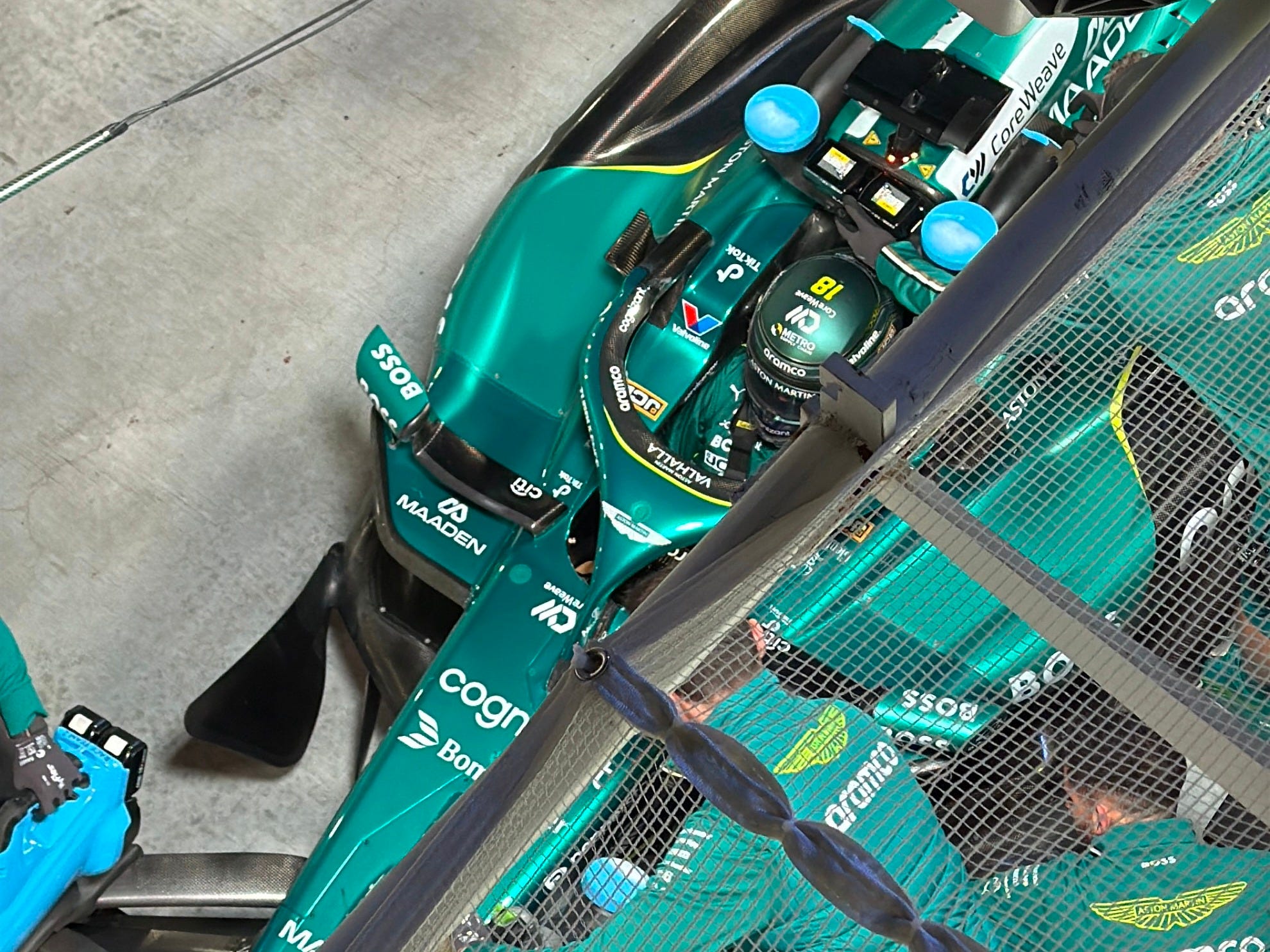
The Aston Martin F1 Team launch happened, and design legend Adrian Newey insists that the 2026 Aston Martin car is one of the more extreme interpretations of the new rules. The team decided to hold their launch in Saudi Arabia - home to their title sponsor, the Saudi Arabian national oil company, Aramco. The AMR26 is definitely the talk of the town and will feature a matte satin finish for the first time, which raised all kinds of questions for me around paint finish and the use of vinyl versus paint on F1 cars. In a strange update, however, Newey admitted during Monday's launch that the team had no time to paint the car for the Barcelona shakedown, which is why it ran in black livery instead.
The McLaren F1 Team launch happened, and well, that’s about it. In some way,s they are the reigning World Champions, so they probably don’t need the eyeballs and press, but then you could also argue that this is the exact reason they should go all-out with their lively launch. By all standards, the launch was a success and the livery itself drew lots of chatter. However, one announcement stood out to me, and that was the announcement of a new global initiative aimed at helping redefine fan access and transforming race-day energy into unforgettable experiences. They created two new positions of Team Priceless captains of the McLaren F1 team - another way of bringing in creators and getting fans involved.
One video worth your time
With profitability now within reach for every team on the grid, Formula 1 has evolved into a sophisticated multibillion-dollar ecosystem. This episode of the Performance Layer explores the three core revenue pillars - media, promotions, and sponsorships - that are fueling the sport's massive financial turnaround. It’s a decent overview of the landscape without getting too granular.
One [event] that caught my eye
For anyone based in San Francisco, it looks like the Red Bull F1 team will be hosting a showrun, presented by Ford, in the city on February 21st (next weekend). This is a free-for-all event that you won’t want to miss. Yuki Tsunoda, a fan favourite, will take centre stage at the Red Bull Showrun, driving Sebastian Vettel’s championship-winning RB7 along the San Francisco waterfront. This city-first exhibition will transform the urban streets of the Marina into custom-built tracks, where championship-winning F1 cars and Ford vehicles will unleash their power. I always love the concept of putting an F1 car where it doens’t belong, and no one does that better than Red Bull.
“I can’t wait to get back behind the wheel of an F1 car and to do that in RB7 in San Francisco will be amazing,” said Yuki Tsunoda, Red Bull Test and Reserve driver. "I’m really looking forward to getting out there, doing some donuts and making some real F1 noise in front of the crowds.”