


Thank you for being here. You are receiving this email because you subscribed to Idée Fixe, the newsletter for curious minds. I’m Toni Cowan-Brown, a tech and F1 commentator. I’m a former tech executive who has spent the past five years on the floor of way too many F1, FE, and WEC team garages, learning about the business, politics, and technology of motorsports.
⏳ Reading time: 10 minutes
Traditional concours like Pebble Beach risk becoming automotive nursing homes - beautiful, reverent, but disconnected from the next generation. Then there is The International Concours of Elegance St. Moritz, otherwise known as “the I.C.E'“ (a clever double-meaning acronyme). And it might just be showing the way forward.
Young collectors believe in driving them. Modifying them. Using them. They’re more interested in experience than provenance, more concerned with how a car makes them feel than whether every bolt is original-spec.
The question isn’t whether to design for social media. It’s whether you’re willing to let your cultural tradition die because you found the medium distasteful. And so I decided to speak with one of the key people, Marco Makaus, who, along with his partner for this project, Ronnie Kessel, has designed a new way for car collectors to come together.
I was initially drawn to this event for its undisputed beauty, but as I dug into the event - the why, the how, the what and the who - I had many more questions than I initially thought I would. Because this event is like nothing I’ve ever seen before - and I think that’s by design.
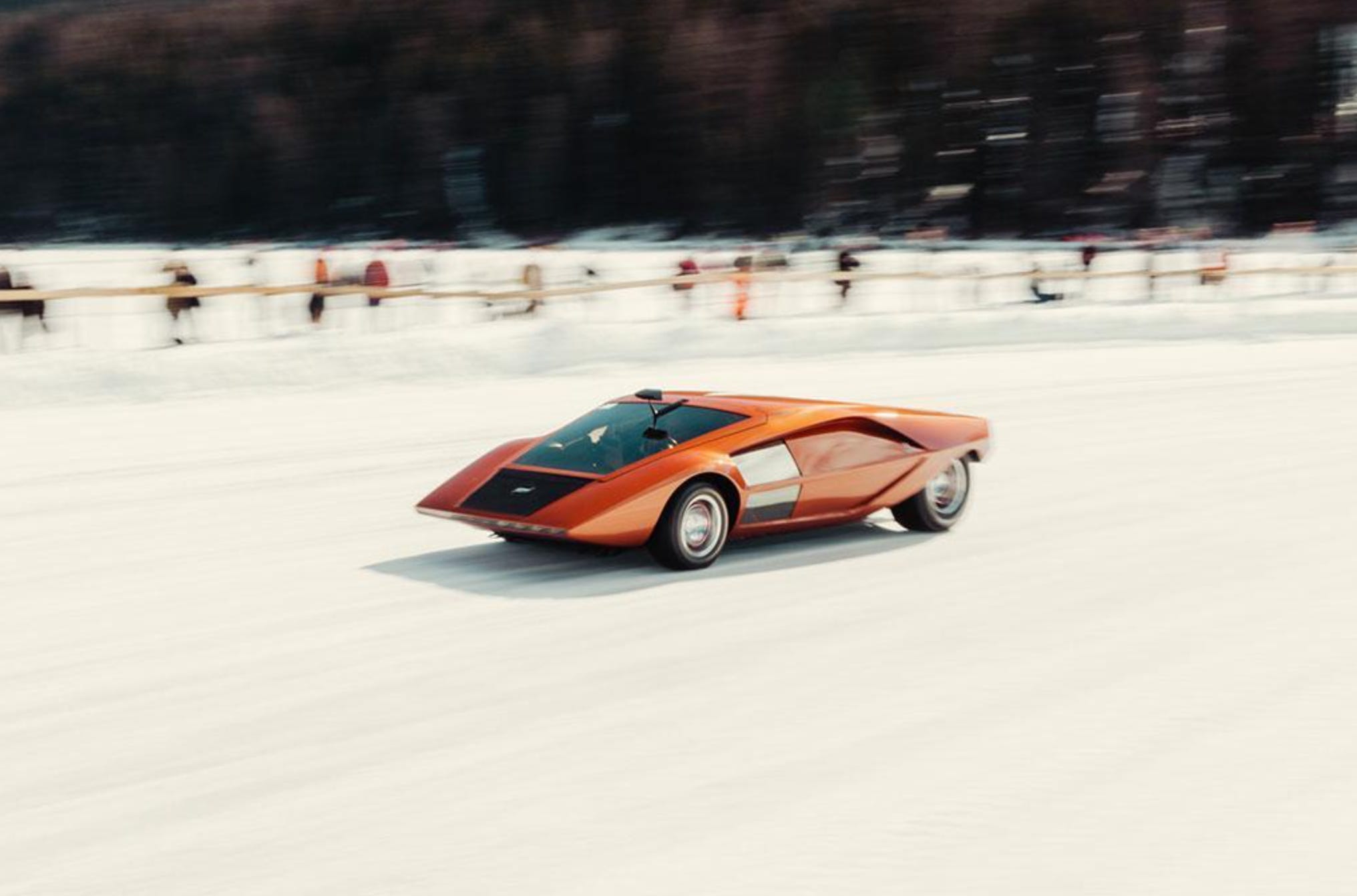
See, there’s a moment in every cultural tradition when we must decide whether to ossify or evolve. For the world of concours d’elegance - those manicured lawn gatherings where collectors display vintage automobiles like jewellery - that moment is now. This was already made very clear during Pebble Beach this year, with the influx of TikTokers and YouTubers clearly disturbing the peace and the ‘usual’ way of doing things. And here’s the thing: the question isn’t whether these events will survive the next generation. It’s whether they deserve to.
Enter The I.C.E. St. Moritz, a concours that swapped grass for ice, stasis for motion, and quiet reverence for adrenaline. Held on the frozen lake of St. Moritz each January (weather permitting, more on that later), it represents perhaps the most radical rethinking of automotive gathering since the first Pebble Beach Concours in 1950. But more importantly, it might be the blueprint for keeping classic car culture alive.
When Makaus first had the idea that would eventually lead to The I.C.E. St. Moritz, he would never have imagined the result we are seeing today. And this, as he explains, “is mainly due to the vision and drive of my partner-in-crime, Ronnie Kessel, and his talented team. Not surprisingly, they are much younger than I am, and this explains how we as a team have been able to read the spirit of the new generations...”
Assumptions and the data that changes everything
Here’s an interesting paradox: the classic car world is far healthier among young people than most expected, but traditional concours events are struggling to evolve. The I.C.E. might be uniquely positioned to bridge this gap. So let’s start by dispelling the conventional wisdom that young people don’t care about old cars. The numbers tell a different story.
According to Hagerty’s research, Gen Z expresses greater interest in classic car ownership than Baby Boomers - 60% versus 31%. Even more striking: classic car ownership is already highest among Millennials, with 25% owning a classic compared to lower rates in older demographics. Since 2016, Millennial-owned classics insured through Hagerty have increased 270%, while Boomer ownership grew a modest 39%.
The narrative of dying interest is not actually accurate. What’s actually dying is the format through which that interest has traditionally been channelled. Because here’s the catch: young collectors want fundamentally different things than their predecessors. They want to drive their cars, not merely preserve them. They see cars as part of a broader lifestyle aesthetic, not isolated trophies.
Traditional concours events - those static displays on pristine lawns, celebrating pre-1975 coachbuilt masterpieces, judged by panels of grey-haired experts - were never designed for this audience. They were designed for their grandfathers, and it’s time to move on.
And as Marco Makaus put it, “We have seen that the traditional collectors are often against using the cars in winter, let alone on a frozen lake! Our participants embrace the thrill and enjoy the cars more in those two days than in previous years.
Reinventing the concours d’élegance for the Instagram age
How do you preserve automotive heritage when the next generation of collectors wants to modify and drive their cars, not keep them museum-perfect? The I.C.E.'s dynamic format might be the answer.
What became clear to me as I was doing my research is that the I.C.E formula is incredibly intentional and the uniqueness surrounding the event serves a specific purpose. When I asked Makaus if he was intentionally trying to solve something, he explained how he had become increasingly frustrated with the fact that traditional car shows were the same. He went on to explain that “the more I saw, the more I found that the fun factor was diminishing. It all worked in one direction: a car show where there is more fun to be had than just kicking tyres.” Beyond this statement, four things became apparent:
The dynamic element: make them move. As younger affluent consumers prioritise experiences over possessions (yet paradoxically are buying more classic cars), events must offer more than static displays. The I.C.E.’s takeover of the entire town is the concours equivalent of Coachella’s evolution from music festival to cultural happening. Unlike most major concours, the I.C.E. doesn’t just display cars. On Saturday, owners drive their million-dollar machines across the frozen lake in what the organisers call “free laps”.
This isn’t just spectacle (though it is certainly that). It’s philosophical alignment with how younger collectors actually want to engage with cars. The “drive it, don’t hide it” ethos that defines Millennial car culture finds its natural expression here. When a 1961 Ferrari 250 GT SWB slides across frozen water with the Alps as backdrop, it stops being a museum piece and becomes a living object again.
The risk is real. But the message is clear: these cars were built to be driven, even if that means occasionally on surfaces they were never intended for.
The experience economy, aka “sell the moment, not the machine” The I.C.E. explicitly describes itself as evolving “from an automotive event into a true cultural movement.” Throughout the weekend, St. Moritz becomes a canvas for art installations, design exhibitions, exclusive dinners, and cultural programming that extends far beyond the cars themselves.
Recognising that younger audiences don’t attend events for single-purpose consumption. They want totality of experience, Instagram-worthy moments at every turn, the feeling of participating in something culturally significant rather than merely observing it. The 2025 edition drew over 20,000 visitors, record-breaking attendance for an event that limits access to protect the lake environment. People aren’t just coming to see cars. They’re coming to be at The I.C.E., and collect that specific memory. Traditional concours treated the car as the entire point. The I.C.E. treats it as the anchor for a broader lifestyle proposition.
Beyond those “picture-perfect and designed-to-share” moments. The I.C.E. has an inherent advantage that few concours can replicate: it’s almost impossible to take a boring photo there. Cars on ice, mountains behind, dramatic weather, motion, risk -every element conspires toward visual drama. But this isn’t accident. The entire event is architected for the social media era. The limited-time nature (the lake only freezes for weeks, not months) creates scarcity and FOMO.
To older collectors, this might feel like pandering. But here’s the educational truth: visibility is preservation. If classic car culture lives only in the physical presence of increasingly elderly collectors, it dies with them. If it lives on thousands of Instagram feeds and TikTok videos, reaching young people who didn’t know they cared about a 1934 Bugatti Type 59 until they saw one powersliding across a frozen lake, it survives.
The preservation paradox. If the point is to maintain automotive heritage for future generations, does it matter if the cars survive if the culture around them doesn’t? What good is a perfectly preserved 1961 Ferrari in 2050 if nobody cares?
This is the paradox at the heart of all cultural preservation: the very act of keeping something alive requires changing how it lives.
The logistics angle: engineering an event on disappearing ice
By this point, it should be obvious that The I.C.E. isn’t just a car show - it’s a complex engineering project that requires unprecedented collaboration between luxury event organisers and glaciologists. Not a sentence I ever thought I would be writing and here’s where the whole enterprise tips into tragicomedy.
So let’s talk about the logistics of pulling off this event because they truly are one-of-a-kind. Makaus kindly reminded me that “very successful Polo and horse racing events have been organised on the frozen lake of St. Moritz for more than a hundred years: consequently, there is a local world-class know-how regarding safety, organisation and logistics” for running such an event.
The I.C.E. depends on a frozen lake that’s freezing for 12 fewer days than it did 50 years ago. Alpine lakes are shrinking their ice season at an accelerating rate, warmer winters producing thinner ice with reduced load-bearing capacity. The window for hosting events is closing, year by year, while the costs of ice monitoring and preparation climb. This isn’t theoretical. It’s an engineering reality that plays out in real-time every winter. The process begins when ice reaches just 6cm thickness - barely enough to support a person standing still.
As Makaus points out, a very interesting quantitative monitoring system is in place, which tracks the ice thickness and its conditions during the formation period (from mid-December to the end of January) and during the event. Ground-penetrating radar sweeps the surface, and electromagnetic waves create colour-coded maps that show thickness variations down to the centimetre. Makaus explains further, “hundreds of sensors are distributed on the lake and coordinated by a computer system that gives a constant real-time vision of the lake, the ice – with the possibility of checking the various areas where different parts of the event are taking place.
At 27cm, Infra AG - the specialised company that monitors lake conditions - requests approval for the “Green Phase” from St. Moritz authorities. But approval isn’t granted until crash tests are conducted with a 7,700kg snow grooming machine fitted with safety floats and a 3,500kg snow-track vehicle. These machines must successfully traverse the entire event area multiple times before construction begins.
By event day, the ice reaches approximately 45cm thick. For context, standard safety guidelines recommend 20cm for a small pickup truck, with vehicles parked 50 feet apart and moved every two hours to prevent sinking. The I.C.E. is putting multi-million dollar irreplaceable automobiles on this surface, along with hospitality villages, tents, spectators, and infrastructure.
Then there’s the snow problem - a paradox that feels designed to test your understanding of physics. Snow acts as an insulating blanket that slows freezing; ice under snow is thin and weak. So the organisers must actively groom the surface, using machines to compact snow to facilitate ice growth. Too much snow prevents adequate freezing. But the event’s entire aesthetic depends on that pristine white surface.
In 2024, despite efforts beginning at 5am to prepare the lake village, 60cm of fresh snow fell in 16 hours. The event was cancelled for safety reasons. Nature, it turns out, doesn’t care about your sponsorship commitments. Makaus and the wider team responded by moving the 2026 event forward three weeks to late January. The official reason is “strategic positioning settled in agreement with St. Moritz and other lake events to optimise logistics.” The unstated reason might be simpler: get the event in earlier when ice conditions are more reliable, before the season gets too warm.
Now here’s the detail that turns this from light irony to fascination: the glaciologist ensuring The I.C.E. can safely happen is Felix Keller, who spends the rest of his time trying to save Alpine glaciers from the effects of climate change.
Keller leads the “MortAlive” project, attempting to delay the melting of the Morteratsch Glacier by 30-50 years using innovative snow-making technology that requires no electricity, buying “breathing space” for 800 million Himalayan people who depend on glacier water. He’s also part of the world’s only “glaciologist tango duo” who perform music to raise awareness about glacier conservation.
So the man enabling a luxury car event celebrating combustion engines is simultaneously fighting to save ice from the emissions those engines produce(d). He’s both facilitating the spectacle and documenting its inevitable obsolescence. He’s making the party possible while knowing exactly when it ends. And yet I see the rhyme and reason to it all.
The imperfect metaphor
This temporal limitation might be precisely the point. Young collectors have grown up with climate anxiety as an ambient condition; the knowledge that nothing lasts is woven into their understanding of the world. An event that might not exist in 20 years, that depends on natural conditions growing increasingly uncertain, carries its own kind of urgency.
Which makes it, accidentally or deliberately, the perfect metaphor for everything it celebrates: beautiful, excessive, temporary, and running on borrowed time. For Makaus though, “this may give an additional ‘now or never’ push to some car collectors, but I believe this to be a background threat. As far as I know most of our participants just see The I.C.E. as a novel proposal and the opportunity to enjoy and use their automobiles in a new and different way, which is just not available elsewhere.”
My biggest takeaway from The I.C.E is that we need more cars to live dangerously than die beautifully in a garage. Scarcity and impermanence create meaning. Traditional concours assume permanence. The I.C.E. knows better. I am not sure if this was the intent as a message when this concours was created, yet somehow this juxtaposition is what really tied it all together for me.


Unfortunate name for the times we live in. Turned me off TBH and confess couldn’t read past the first para. Too soon.
It is kind of weird reading the news and sm timelines concerned about the absolute abuse of power by the ICE and then having this in the mailbox. Maybe you could reschedule this newsletter. It might be not the right time