


Thank you for being here. You are receiving this email because you subscribed to Idée Fixe, the newsletter for curious minds, read by young and affluent insiders in motorsport.
I’m Toni Cowan-Brown, a tech and F1 commentator and the Editor-At-Large at Esses Magazine. I’m a former tech executive who has spent the past six years on the floor of way too many F1, FE, and WEC team garages, learning about the business, politics, culture and technology of motorsports.
⏳ Reading time: 6 minutes
This is one of those pieces I’ve sat down to write a dozen times without ever finishing. Every time I think the research is done, or I’ve finally mapped all the layers, something new surfaces and my thesis starts to buckle. So let me start where I actually am.
Formula 1 has become the new honey, and everything is trying to get near it. Every sector, every brand, every marketer with a fleeting adjacent interest has decided that F1 is both a business tactic and a cultural shorthand. And with that has come a particular kind of opportunism: the expert who isn’t quite an expert. Podcast guests casually dropping that they “worked in F1” - only for a quick search to reveal they wrote a paper on an F1-adjacent topic and conducted a few interviews. This, apparently, now counts. The fact that it even needs to be said is its own kind of commentary.
The rise of AI-generated content has accelerated all of this. The barrier to entry - even to the fringes of this space - has collapsed. Anyone can have an opinion; the internet will happily distribute it. But here’s the flip side, and it’s the part I’m genuinely energised by: volume has never been a substitute for expertise. The people with real knowledge, genuine experience, and a distinct point of view will not just survive the noise, they’ll be the ones who last. It raises the floor for all of us, and I think that’s worth getting excited about.
But knowledge alone may not be enough anymore either. Which brings me to the question I keep circling back to: if access was once the cultural currency, and knowledge replaced it, is taste next?
There's a particular image that lodged itself in the cultural imagination earlier this year: Mark Zuckerberg and Priscilla Chan walking into the Prada show at Milan Fashion Week, dressed head to toe in the brand, filming themselves on Meta Ray-Bans, and posting it to Instagram. To be clear, they were not sporting the Meta Ray-Bans but they were front row at teh Prada show.
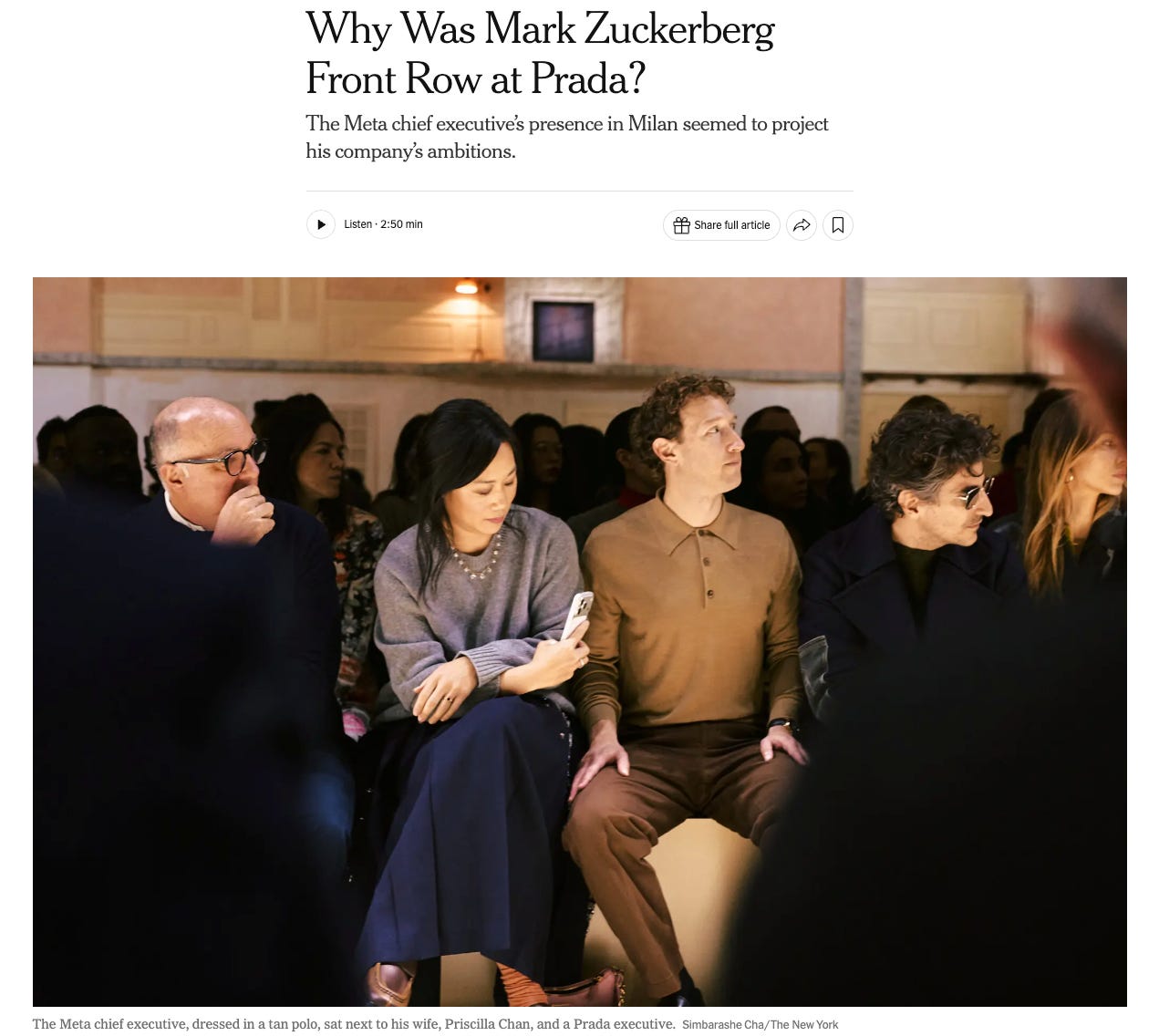
Every detail of that appearance was a product placement, and it was intentional from every angle; there is nothing really new there. But beyond the obvious commercial choreography, it felt like something else. Something more anxious. Something that rhymes with a question the internet has been asking for months: what exactly is taste, and why does everyone suddenly want it so badly?
Tech's relationship with fashion has always been one of quiet contempt - the industry that broke the world wore hoodies to prove it didn't need to care. A decade ago, many fashion insiders might have recoiled at Zuckerberg walking into the coolest runway show in the world. It would have been taken as corruption or hypocrisy. Real fashion was art. Self-expression. Not another way to hoard cash. And yet here we are. Bezos and Sánchez-Bezos have become front-row regulars, attending Schiaparelli and Dior during Paris Couture Week and co-chairing the Met Gala. The tech bros have discovered fashion - and fashion, hungry for capital and headlines, has let them in. Vanessa Friedman, in a piece for the New York Times, absolutely nails it.
“As tech has become mainstream, it has realized it is integrating into pop culture,” said Venky Ganesan, a partner at the investment firm Menlo Ventures. “And there is nothing more popular than high fashion.”
Scott Galloway, the tech pundit, podcaster and venture capitalist, called it “an exchange of value.” “Tech has too much money and too little cool,” he said. “Fashion has too much cool and too little money.” They are effectively making a trade, of sorts.


Does fashion even need tech?
The question worth asking isn’t why fashion is letting them in. That answer is boring: money and power. The more interesting question is why they want in at all. Proximity to luxury brands is cultural capital and unlocks visibility. It signals taste and brings a certain coolness and exclusivity that money alone can’t buy. It’s a form of image-making that portrays them as someone culturally fluent.
But as Jade Conner writes in The Cheque Book, when everyone starts talking about taste, especially in the same aesthetic tone and on the same platforms, it stops functioning as a mark of discernment and starts reinforcing homogenisation. Sitting front row doesn’t give you taste. It gives you proximity to taste, which is an entirely different thing, and a much emptier one.

In some ways reminds me a lot of a good portion of the people peacocking in the Formula 1 Paddock, where it is worth reminding them that proximity to power doesn’t actually mean power. As I’ve been watching this same energy flood into the paddock over teh past few years, it’s become apparent that it’s coming from the same place, and potentially, the same necessity.
Formula 1 as a taste proxy
F1 teams generated a record $2.04 billion in sponsorship revenue in 2024, with tech leading the pack. Total global F1 sponsorship spend is expected to exceed $3 billion for the first time in 2026, driven significantly by tech players. Then there’s fashion: LVMH signed a 10-year deal described as an unprecedented agreement between the world leader in luxury and the pinnacle of motorsport, reportedly worth more than $1 billion, with annual fees topping $100 million. Two industries, moving simultaneously, in the same direction. Two industries that probably need each other, although it may not feel like it right now.

Now, here’s where I want to push back slightly on the framing because I think the two industries are actually pursuing F1 for slightly different reasons, and that distinction matters. Tech’s investment in F1 has a functional logic: Oracle invests in cloud infrastructure and AI solutions to fine-tune car performance, while Google partners with McLaren to develop data analytics platforms and machine learning tools. These companies are using the sport as a laboratory. The ROI is real and measurable. The cultural cachet is a bonus, not the point.
Fashion’s investment is almost entirely the reverse. LVMH isn’t in F1 to make better handbags. It’s there because F1 has become one of the few spaces that still generates genuine aspiration - the kind that can’t be manufactured through content strategy or influencer seeding. Over half of new U.S. F1 fans are female, and 47% of those who have followed the sport for five years or less are aged 18-24. That’s not an audience luxury fashion already owns. That’s an audience they desperately want.
And so both industries have landed at the same destination via different roads: F1 as a taste proxy. A cultural object that is genuinely difficult to fake engagement with. You cannot simply show up to a race and absorb its credibility the way Zuckerberg tried to absorb Prada’s by sitting in the front row. The sport resists that. It’s too technical, too historical, too specific. True taste is stubbornly individualistic - it emerges gradually, through personal choices that might seem puzzling or eccentric to others but make perfect sense internally. It’s not sexy to build. It’s slow, frustrating, and sometimes embarrassing. F1 fandom, at its core, works the same way. What I’m trying to say is that I think we are going to see a rise of tastemakers and curators of taste in Formula 1, just like we saw the rise of educational content creators in sports over the past few years.
What tech and fashion are both discovering - somewhat to their discomfort - is that F1 offers something their own industries have been struggling to protect: the feeling that you earned your place in it. Fashion’s power needs to be coaxed out like a flame in the damp. You can’t do that with a wad of cash. Neither can you do it with a title sponsorship or a branded trophy trunk.
And the irony - rich and appropriate - is that the people who’ve spent the least time trying to own it understand it best.
I know approximately nothing about F1, but I’ve been listening to you and Benedict from the beginning, and therefore have ample reason to trust your judgement. When it comes to tech and F1, what’s your read on Atlassian and Williams?