


Thank you for being here. You are receiving this email because you subscribed to Idée Fixe, the newsletter for curious minds. I’m Toni Cowan-Brown, a tech and F1 commentator. I’m a former tech executive who has spent the past five years on the floor of way too many F1, FE, and WEC team garages, learning about the business, politics, and technology of motorsports.
⏳ Reading time: 6 minutes
Let’s talk about what Apple and F1 pulled off, because I don’t think we’ve given it nearly enough credit. I remember walking the pit lane ahead of the 2024 Las Vegas GP and being impressed and confused by what I was seeing. It wasn’t the F1 cars that caught my eye, but rather the hyper complex, yet pretty compact nonetheless, Apple filming setup that was happening right before my eyes.
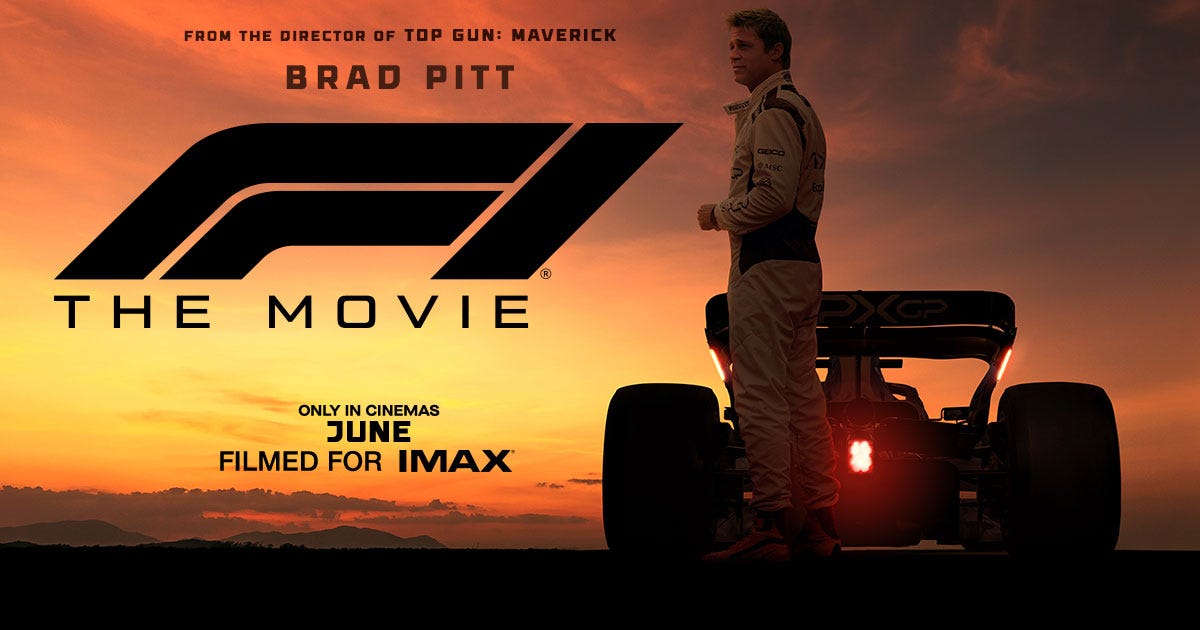
The F1 Movie wasn’t just a good film. It was a calculated and long-game business move dressed up as a Hollywood blockbuster. And it worked spectacularly. Apple - a company that still hasn’t fully cracked the streaming wars (but it seems to be taking a new approach) - co-produced a global theatrical release that grossed over $630 million at the box office worldwide, got the F1 teams to play along, and turned Damson Idris into a de facto brand ambassador for the sport. Meanwhile, Formula 1 got a two-hour global advertisement that no marketing budget could have bought. And let’s not forget teh big winner of teh movie - Expensify. Liberty Media must be absolutely delighted. And rumour has it that the sequel is already confirmed.
But here’s the thing that got lost in all the discourse about Brad Pitt’s age and whether the racing was “realistic enough”: to make this film, they had to invent things that didn’t exist yet. New cars. New cameras. New systems. And that’s the story I want to tell today. Oh and did you know that some scenes from the movie were filmed on the iPhone 15 prototype?

First, the car problem
You can’t just stick a film crew in the Paddock and hope for the best. Real F1 cars cost tens of millions of dollars, belong to the teams, and travel at speeds that make “just get a bit closer” a medically inadvisable suggestion. So the production did what any reasonable Hollywood team would do: they built their own.


Starting with a Dallara F2 chassis - the same platform that serves as the official F1 feeder series - they stretched and widened it to bring the proportions closer to a current-spec 2025 F1 car. Then Mercedes-AMG Applied Science (yes, that’s a real division) fabricated full F1-style bodywork to bolt on, complete with aero geometry that wouldn’t look out of place on the actual grid.
And they didn’t just build one version. They built several: a traditional gas-powered variant for high-speed track work, a hybrid version, and a fully electric one specifically designed for pit lane filming, where combustion engines aren’t permitted. That last detail tells you everything about how seriously this production took authenticity, which you have got to appreciate.
Then, the camera problem
Director Joseph Kosinski has done this before. Top Gun: Maverick was essentially a proof of concept for exactly this approach: miniaturise cinema-grade cameras, mount them where no camera has ever been, and let physics do the cinematography. For the F1 Movie, he brought back his Top Gun DP Claudio Miranda and 1st AC Dan Ming, and they asked a simple, terrifying question: can we go even smaller?
The answer required Sony to build a camera that had never existed. The production went to Sony in late 2022 with a brief that probably went something like this: “We need a cinema camera that can fit inside an F1 car, survive 180+ mph, withstand extreme G-forces and vibration, and still deliver IMAX-quality footage.” Sony spent six months engineering a super-compact prototype. The camera head was physically separated from its recording body and connected via a tether cable - necessary because there simply wasn’t enough space in one place. The image performance matched Sony’s FX6 and FX3 cinema cameras, with remote operating capabilities borrowed from the FR7. The crew nicknamed it Carmen. Even director Kosinski called it Carmen on set.
Carmen was roughly half the size of the cameras used on Top Gun: Maverick. Panavision then custom-manufactured the panning heads - capable of rotating 720 degrees - that would mount Carmen at up to 16 different positions designed into the chassis. The lenses needed custom focus rings fabricated by Panavision because the Voigtländer primes they selected weren’t built to accept standard focus gears. Every single component of this system was purpose-built for this film. So if you are accustomed to watching F1 races on TV, you watched the movie and felt this was like nothing you had ever seen before. Well, it’s because they put cameras in places we had never had them before.
Productions typically ran four cameras per car simultaneously. The recording brains, batteries, and transmitters were housed in the sidepods - specifically under the radiators - to keep mass centralised and minimise aerodynamic disruption. Back at “mission control,” Miranda and Kosinski could monitor feeds from all cameras across multiple cars on track, adjusting framing, focus, and exposure in real time over a mesh IP network covering the entire circuit. They were, in effect, operating cameras at 200 miles per hour from a TV truck in the pit lane.
Then Apple went further
Here’s where it gets really interesting for anyone who follows Apple as a technology company rather than just a phone manufacturer.
The standard FIA regulations require that F1 cars carry a camera pod - a housing for onboard cameras and transponders - in a prescribed location. These normally contain 720p broadcast cameras. For the F1 Movie, Apple worked with the FIA to replace those standard units with something far more capable: a custom camera built on iPhone-class sensor technology, shooting 4K ProRes RAW, running on iOS with custom firmware, and controlled via a custom iPad app over USB-C.
Some of those onboard shots you saw? The ones that felt impossibly intimate, like you were somehow inside the cockpit? Those came from a deconstructed iPhone - or more precisely, an Apple 15 prototype - mounted where the broadcast camera would normally sit. It shot in log format for maximum colour grading flexibility in post, and because it was physically in the regulation camera pod position, it integrated seamlessly with actual race footage from real grands prix.
The cameras were strategically placed to avoid interfering with the car’s aerodynamic integrity, which meant Apple’s engineering team had to think not just like camera designers but like aerodynamicists.
The combined camera system - Venice 2s for dramatic scenes, Carmen for in-car cinema footage, DJI Ronin 4Ds for additional angles, and Apple’s custom iPhone units for the regulation onboard positions - gave the production something no F1 film had ever had before: the ability to roll up to 16 cameras at once across five vehicles, all remotely operated, all delivering cinema-grade footage, all while the cars were actually racing.
Why this matters beyond the movie
So even if you didn’t enjoy the movie, you’ve got to admit that teh technology and production behind it is absolutely incredible. And even more impressive is that what Apple and the F1 production team built isn’t just state-of-the-art film tech; it’s a roadmap. The Carmen system demonstrated that a cinema-grade, remotely operated camera can survive the most hostile environment consumer electronics will ever face. The iPhone-based onboard unit proved that smartphone sensor technology can deliver footage suitable for the largest IMAX screens in the world.
And the sequel is coming. Which means they’ll iterate. Whatever Carmen 2.0 looks like, it’ll be smaller, smarter, and mounted in places that will make the first film look positively conservative.
For Apple, this was never really about making a film. It was about demonstrating - at blockbuster scale, in front of a global audience - exactly what their technology can do when the constraints are extreme, and the stakes are real. That’s not a marketing campaign. That’s a proof of concept. A perfect segue into Apple now having the broadcast rights in America for F1.