


Thank you for being here. You are receiving this email because you subscribed to Idée Fixe, the newsletter for curious minds, read by young and affluent insiders in motorsport.
I’m Toni Cowan-Brown, a tech and F1 commentator and the Editor-At-Large at Esses Magazine. I’m a former tech executive who has spent the past six years on the floor of way too many F1, FE, and WEC team garages, learning about the business, politics, culture and technology of motorsports.

⏳ Reading time: 8minutes
Shift Happens, weekly pivots where motorsport collides with tech and culture. And a quick roundup of the headlines in and around motorsport, you should be aware of, as they explain the cultural shifts we are seeing in this space.
As I finish up this newsletter, I’m simultaneously planning and packing for the next two weeks’ double header - the Monaco F1 GP and the 24h of Le Mans. For Monaco, I’ll be on the ground working with the FIA and a handful of other stories, and for Le Mans, I’ll be joining Genesis Magma Racing on a press trip, which leads nicely into some of the stories that caught my eye this week.
The [lead] lap
Last weekend, a Major League Soccer match between LA Galaxy and Houston Dynamo was shot entirely on iPhone 17 Pro — warmups, player introductions, in-net goal angles, the lot. Apple called it the first time the iPhone had been used to capture the entirety of a major professional live sporting event broadcast. It’s a headline that lands as a product flex, a “shot on iPhone” campaign taken to its logical extreme. I’ve said this since day one: Apple isn’t in Formula 1 purely for the content game and broadcast rights; they are in it for so much more.
Apple secured exclusive US broadcast rights for Formula 1 in October 2025, signing a five-year deal worth north of $140 million per year. The framing at the time centred on streaming, on the post-ESPN era, on F1’s demographic shift toward younger American audiences. All accurate. But to me, the broadcast rights are the visible layer. The architecture underneath is what I’m most excited about.
Alongside F1 on Apple TV, Apple is amplifying the sport across Apple News, Apple Maps (they even took out Apple TV billboards at the track in Miami in Maps), Apple Music, Apple Sports, and Apple Fitness+, with Apple Sports featuring live updates, real-time leaderboards, and season standings for every qualifying session and Grand Prix. That’s not just about content distribution, that’s a full vertical integration. F1 becomes the flywheel that keeps people cycling between Apple products. Watch the race on Apple TV. Follow it on Apple Sports. Listen to the build-up on Apple Music. Navigate to the circuit watch party on Apple Maps. Each touchpoint reinforces the next. Eddy Cue put it plainly at the Autosport Business Exchange: Apple doesn’t want to “do sports the way they are” because the world doesn’t need another broadcaster doing that. The strategy only makes sense if Apple can do something unique, something it’s always tried to do, but many will argue they haven’t changed the game in over a decade. So could this be the opportunity to do just that - reinvent how we consume live sports events?
F1 The Movie is one place where you can see exactly what that means in practice. The filmmakers behind F1 weren’t satisfied with traditional broadcast angles - those familiar shots from just behind the cockpit that, while functional for live TV, record in lower resolutions and limited colour formats, making them ill-suited for the immersive cinematic vision director Joseph Kosinski and cinematographer Claudio Miranda had in mind. So Apple built something new. Apple’s engineering team extracted the broadcast module from the F1 car and replaced it with a camera built from iPhone parts, running on custom iOS firmware and recording in ProRes lossless. In collaboration with Formula One, the FIA, and Apple engineers, the resulting custom cameras were placed on two competing cars during actual races. That custom firmware work didn’t stay inside the movie. It helped release two new features on the iPhone 15 Pro. The film was, in part, a product development exercise conducted at 200mph.
Which brings us back to Saturday’s MLS broadcast. An entire live professional sporting event, every angle, shot on iPhone 17 Pro. Apple had already proven the concept with a 2025 Friday Night Baseball matchup, using iPhone 17 Pro for select moments. The MLS match, however, was the full commitment. Apple has spent the last two years proving that iPhone hardware belongs inside professional broadcast infrastructure - first in cinema, then in live baseball, now in a full live football production. So naturally, the question I have now is: will we see iPhone cameras integrated into the F1 broadcast in the years to come?
The F1 broadcast deal lands differently when you read it through this lens. It isn’t primarily about streaming rights. It’s about owning the context - the platform, the content, the camera technology, the distribution. Apple now controls what F1 looks and sounds like in the US.
The [number] of the week
0.0233
That’s the time that separated Felix Rosenqvist from David Malukas at the finish line of Sunday’s Indianapolis 500, making it the closest finish in the race’s 110-year history. The Swedish driver surged from third to first in a one-lap shootout, going side-by-side with his own Meyer Shank Racing teammate before breaking free and making a dramatic late pass on Team Penske’s Malukas. The margin eclipsed the previous record set in 1992, when Al Unser Jr. edged Scott Goodyear by 0.043 seconds. To put it plainly: in a 500-mile race that lasted hours, it came down to roughly the time it takes to read the word “go.” This was truly quite the racing spectacle, and it had all the emotions possible.
Three [stories] that need to be on your radar
Gucci Doesn’t Want F1. It Needs It. This is one of those stories I find so fascinating - it’s cool (whether you like it or not) and it’s so incredibly layered. I did a quick video on my initial thoughts, but I wrote a broader piece for the Esses newsletter. For context, here is where I think this story gets genuinely interesting beyond the key stakeholders, Paddock legacy and the balance sheets. Gucci entering F1 as a title partner may represent the first serious test of what the sport has been quietly promising every brand that has rushed to its doors since Drive to Survive: that F1 is not just a backdrop for your logo, but a genuine cultural relevancy engine with measurable commercial return. This is what F1 has become, and what it is increasingly being asked to do. LINK
The “Enhanced Games” - or as critics almost immediately dubbed it, the Steroid Olympics - finally arrived in Las Vegas this past weekend, and the verdict seems to be: a lot of hype, not a lot of payoff. The inaugural event featured roughly 50 athletes competing across swimming, athletics, weightlifting, and strongman, with performance-enhancing drugs not just permitted but openly celebrated. Financially backed by Donald Trump Jr.’s venture capital firm and tech billionaire Peter Thiel, the whole thing was positioned as a provocation - a boundary-pusher of sorts that would rewrite what human performance looks like. Instead, empty seats and underwhelming performances drew fierce criticism, with many calling the event a farce. The livestream numbers were modest for something that promised to upend sports as we know it. Maybe the concept was always more interesting on paper than in practice. Or maybe the aggressively macho, bigger-is-better aesthetic that underpins the whole thing just doesn’t land the same way it once might have.
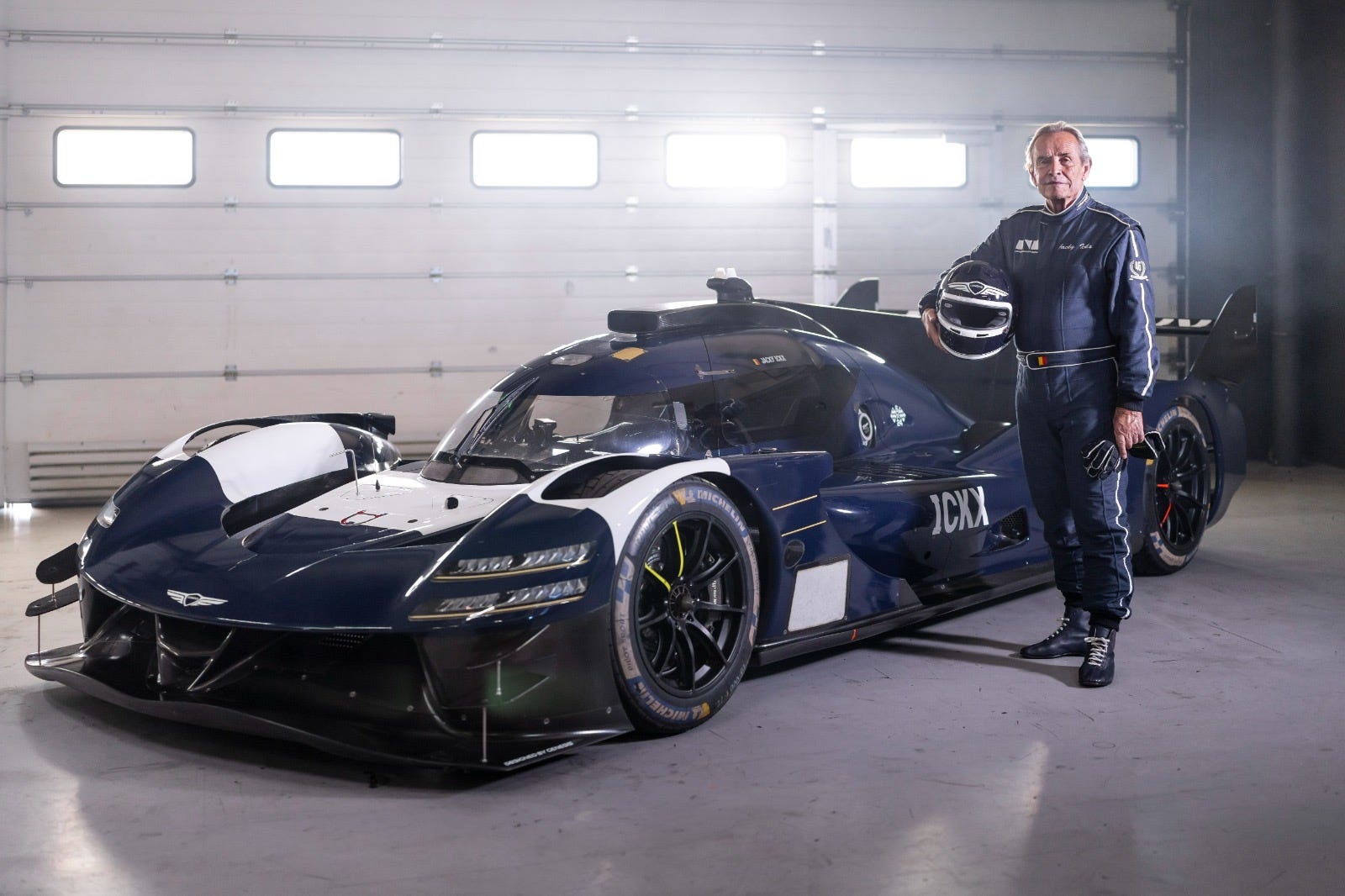
Genesis Magma Racing pulled off one of the most touching gestures in recent motorsport memory. The team invited Jacky Ickx - six-time Le Mans winner, two-time Formula 1 runner-up, and Paris-Dakar champion - to take the wheel of their GMR-001 Hypercar at Circuit Paul Ricard in southern France. But they didn't hand him just any car. Genesis unveiled a special version of the GMR-001 finished in dark blue with a white stripe, directly mirroring the colours of Ickx's iconic helmet design - a rolling tribute to a living legend. For a few laps at Paul Ricard, decades collapsed - a man who raced on instinct alone behind the wheel of one of the most advanced machines on the planet. It was brief, sure, but also incredibly symbolic, and quietly magnificent. I am, now more than ever, convinced that Genesis Magma Racing will run at Le Mans, a livery in their bold Magma orange.


One [video] worth your time
I was not ready to be bawling my eyes out at 8am on a Tuesday, but there I was. I knew this event had taken place, and as soon as I heard it, I understood how special an homage and moment this would be, but nothing quite prepared me for Jacky Ickx’s own reaction and response to the gesture, and how much it would hit me.
One [event] that caught my eye
As the team at The Publish Press put it, “Creators are flocking to Cannes because advertisers are flocking to creators.” I went for the first time last year, and immediately regretted not having this conference on my radar sooner. Because if there's one event that sits at the exact intersection of creativity, culture, media, tech and what's coming next - it's absolutely Cannes Lions.
Every June, the south of France becomes the global room where the interetsing and important conversation actually happens. And for teh past few years, creators are becoming a real part of that conversation, with dedicated programming around the creator economy and how brands are moving from treating creators as a campaign line item to genuine, outcome-driven partners. And what I’ve particularly enjoyed is seeing how the sports track has grown - shout out to Sport Beach, and there are noticeably more motorsports and F1 stakeholders showing up to this event, before they head off to Silverstone.
[Bon goût] - for those with an acquired taste.
The Ritz-Carlton has teamed up with the U.S. SailGP Team, uniting the precision of high-performance sailing with the excellence of luxury hospitality, and it kind of just makes sense. In an era right now, where every brand wants to be seen in Formula 1 - from LVMH to Gatorade, it’s actually fun to see a sport that hasn’t yet been taken over by sponsors and partners. For the New York Sail Grand Prix on the Hudson River, the brand transformed Conservatory Water in Central Park into a sailing activation, while offering guests on-water spectator packages with five-star trimmings. It's the kind of partnership that doesn't feel forced because the DNA genuinely overlaps - both are about precision, craft, and the pursuit of excellence in elevated environments. I really wish I could go back to the NYC SailGP event because when I went with Rolex, I had an absolute blast.